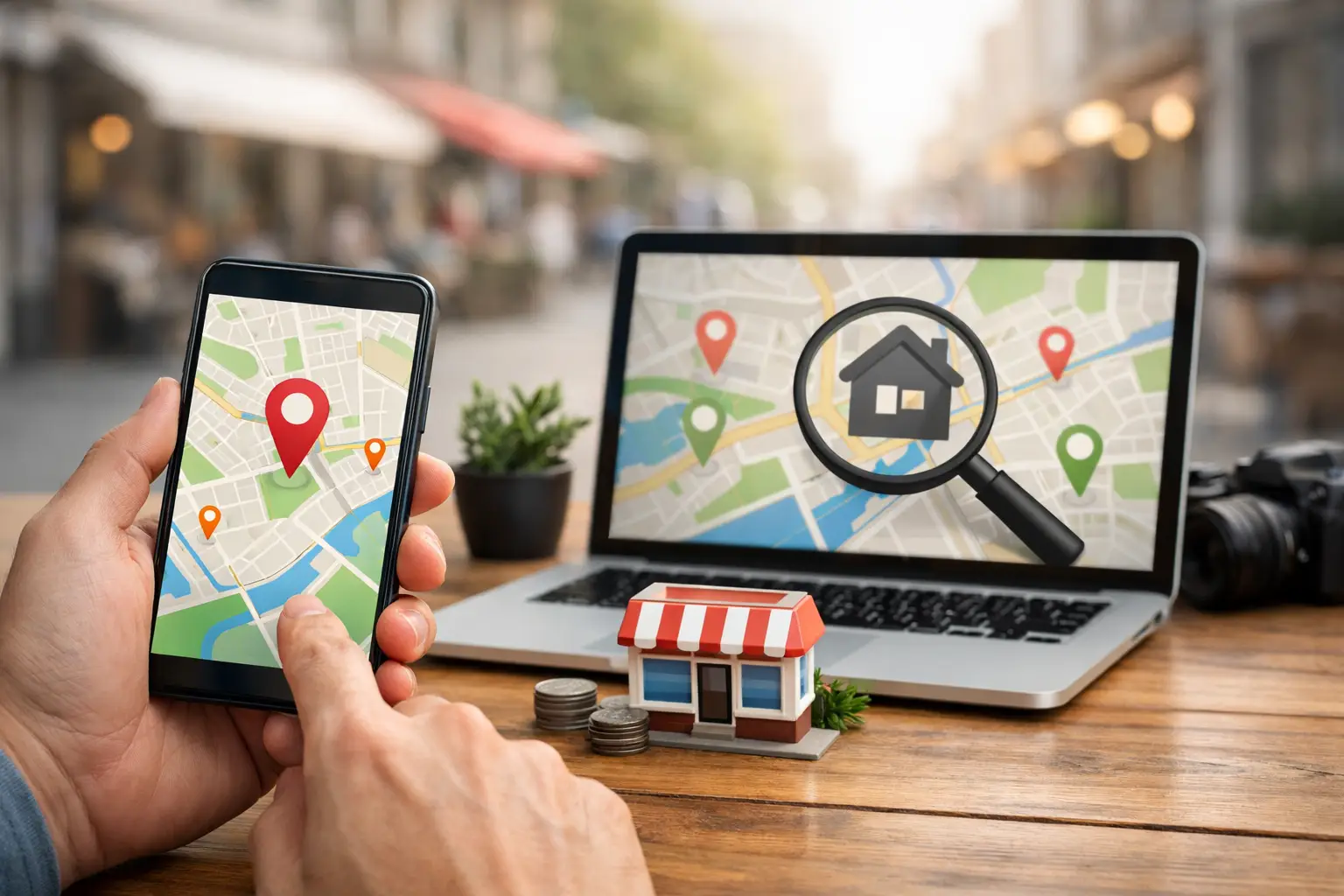
A homeowner's water heater fails at 8:30 p.m. They do not browse social media looking for plumbing inspiration. They search for a plumber near them, compare the first few businesses they see, and call one. If your company is absent from that search, your competitor gets the job, the revenue, and potentially a repeat customer.
What is local SEO marketing? It is the work of making a business more visible when people search for products or services in a specific geographic area. It helps your business appear in Google Maps, the local map results, standard organic listings, and increasingly, AI-generated search answers. For a local service business, that visibility can translate directly into calls, appointments, direction requests, quote forms, and revenue.
Local SEO is not about collecting random website traffic. It is about showing up when someone in your market has a problem, needs a provider, and is ready to make a decision.
What Local SEO Marketing Actually Does
Local search optimization connects three things: what you do, where you do it, and why a customer should trust you. Google and other search systems need clear evidence that your company is relevant to the search, serves the customer's area, and is credible enough to recommend.
A search like "roof repair in Dallas," "family dentist near me," or "commercial electrician in Phoenix" has strong local intent. The person is not researching an abstract topic. They are looking for a business they can contact now. Local SEO marketing puts your company in position to compete for that demand.
The work usually includes improving your Google Business Profile, building location-relevant service pages, correcting business information across the web, earning and managing reviews, strengthening website performance, and creating content that answers the questions local buyers ask before they call.
It also requires conversion thinking. Ranking number one means little if your website is slow, your phone number is hard to find, your forms are broken, or your service page gives visitors no reason to choose you. Visibility gets the opportunity. Conversion turns it into a lead.
Understanding the key local SEO ranking factors helps you prioritize the right work instead of spreading effort across tactics that will not move the needle in your specific market.
Where Your Business Can Show Up
Local search results are not limited to one spot on Google. A well-executed local strategy can improve your presence across several high-value surfaces.
Google Maps and the Local Map Pack
The local map pack is the group of nearby businesses commonly shown near the top of local results. For service businesses, this is often where the highest-intent calls originate. Customers can see your rating, hours, phone number, directions, photos, and reviews before they ever visit your website.
Your Google Business Profile is the foundation here. An incomplete or neglected profile leaves money on the table. The right primary category, accurate service areas, current hours, detailed services, strong photos, regular updates, and review activity all help Google understand your business and help customers trust it.
Organic Search Results
Below the map results are traditional website listings. These matter because many customers want more information before choosing. They may compare service areas, credentials, pricing approach, project photos, financing options, or emergency availability.
A strong local website does not rely on one generic homepage to rank for everything. It gives each important service a focused page, explains who the service is for, identifies relevant locations naturally, and makes the next step obvious. A custom website built around customer action will outperform a pretty site that says very little.
AI Search Results
Search behavior is expanding. Customers are asking ChatGPT, Perplexity, and Google's AI experiences for recommendations, comparisons, and local service options. These systems pull from signals across your website, business profiles, reviews, third-party mentions, and broader web presence.
There is no shortcut that guarantees an AI recommendation. But the same fundamentals matter: accurate information, clear expertise, consistent branding, useful content, real proof, and a website that explains your services better than the next company. Businesses that ignore this shift risk becoming harder to find while competitors build authority early.
The Core Parts of a Local SEO Strategy
Local SEO is not one task and it is not a monthly checklist copied from a generic agency. The right strategy depends on your market, competition, service model, and current visibility problems. Still, most effective campaigns are built on a few core components.
First, your business information must be accurate everywhere that matters. Your company name, address, phone number, website, hours, and service details should match across your Google Business Profile, website, directories, and industry-specific platforms. Conflicting information creates friction for both search engines and customers.
Second, your website needs technical health. If search engines cannot crawl key pages, mobile visitors cannot use the site, or pages load slowly, your rankings and lead flow suffer. Technical SEO is not glamorous, but it is often the reason a business with good services remains buried.
Third, you need pages designed around actual demand. A HVAC company may need dedicated pages for AC repair, furnace installation, heat pumps, maintenance plans, and emergency service. A law firm may need clear practice-area pages supported by location relevance and proof of experience. One vague page cannot do the work of five specialized pages.
Fourth, reputation must be actively managed. Reviews influence conversion and local rankings, but quantity alone is not the goal. Recent, authentic reviews that mention the experience customers had with your business provide stronger trust signals. Responding professionally also shows prospective customers that you are present and accountable.
Finally, authority matters. Search engines look for evidence beyond your own website that your business is legitimate and known in its market. That can come from credible local mentions, industry listings, partnerships, media coverage, and useful content that earns attention. Cheap directory spam is not an authority strategy.
Why Local SEO Marketing Fails for So Many Businesses
Most local SEO failures are not caused by a lack of effort. They happen because the work is disconnected from revenue.
Some agencies send reports filled with impressions, rankings, and citation counts while the owner still does not know whether calls increased. Others chase broad keywords that bring visitors from outside the service area or visitors who have no intention of buying. Those metrics may look good on paper, but they do not pay payroll.
Another common problem is treating the Google Business Profile as a set-it-and-forget-it asset. Categories change, competitors improve, reviews go unanswered, photos become outdated, and duplicate listings appear. Local visibility needs ongoing attention because the market is always moving.
There is also a trade-off between speed and durability. Paid ads can produce leads quickly, especially in urgent service categories, but they stop when the budget stops. Local SEO usually takes longer because you are earning relevance and trust over time. The strongest growth plan often uses both: ads for immediate demand capture and SEO to build a dependable source of lower-cost organic leads.
How to Tell Whether Local SEO Is Working
Do not judge local SEO by rankings alone. Rankings fluctuate by location, device, search history, and the exact wording of the query. A number-one position that produces no qualified calls is less valuable than a number-three position that fills your calendar.
Track the outcomes that affect your business: phone calls, form submissions, booked appointments, direction requests, lead quality, close rate, and revenue where attribution is available. Then compare those outcomes against your investment and against the cost of buying similar leads through advertising.
You should also look at which services and locations generate leads. This is where clear reporting matters. If one service page is driving profitable jobs and another is attracting low-value inquiries, the strategy should change. Marketing without measurement becomes guesswork, and guesswork is expensive. A detailed breakdown of how to tell if SEO is working can help you build the right reporting framework from the start.
What Small Businesses Should Do First
Start with a diagnostic, not a package. Find out where customers are dropping out of the process. Are you invisible in Maps? Is your profile incomplete? Are competitors collecting reviews while yours sit unanswered? Does your website rank but fail to convert? Are you targeting areas where you cannot realistically compete yet?
Fix the highest-impact problem first. For many businesses, that means cleaning up and improving the Google Business Profile while repairing obvious website conversion issues. For others, the priority is building the service pages they never had or resolving technical problems that prevent search engines from properly indexing the site.
Do not try to serve every city within a 100-mile radius with thin, copied location pages. Build real relevance in the areas you can serve well, document your proof, and expand strategically. Honest local authority compounds. Manufactured relevance usually collapses.
The local businesses that win are rarely the ones with the fanciest marketing language. They are the ones that make it easy for a ready-to-buy customer to find them, trust them, and take action. Start by identifying the search that should be bringing you the next call, then build every part of your online presence to earn it.
Jeff Norton Digital works with small businesses to identify exactly where local visibility is breaking down, then builds the foundation that earns real search presence. If you are not sure where to start, the right first step is a conversation about what your local search results currently show and what they should show instead.