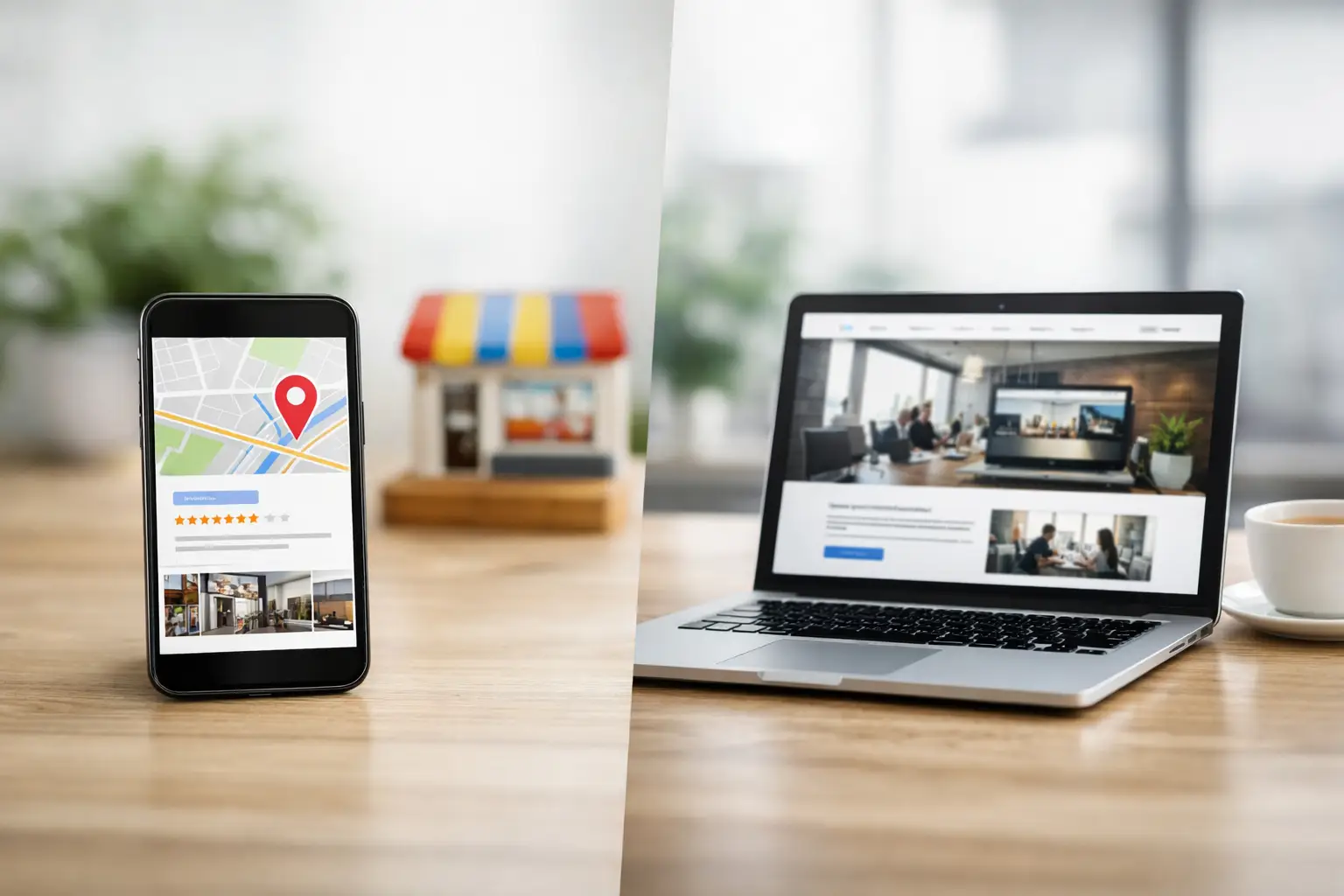
A customer searches for an emergency plumber, nearby dentist, or best roofing company. They do not care whether your lead came from a map listing or a web page. They care whether you look credible, available, and easy to contact before they call someone else. That is the real question behind google business profile vs website: which asset brings in more revenue?
The short answer is both, but they do different jobs. A Google Business Profile gets you into the local conversation when people are ready to act. Your website gives them the proof, information, and conversion path needed to choose you over competitors. Rely on only one, and you leave a gap that competitors can use to take the job.
Google Business Profile vs Website: The Core Difference
Your Google Business Profile is your storefront inside Google Search and Google Maps. It can display your business name, categories, service area, hours, phone number, reviews, photos, directions, services, and updates. For local intent searches, it is often the first thing a prospect sees.
A website is property you control. It is where you explain your offer, establish authority, show past work, answer objections, collect leads, and create pages for every service and location that matters to your business. Google can change the layout of a map result overnight. Your website remains the central asset where your brand, messaging, and customer journey live.
Think of the profile as the high-visibility sign that gets attention at the intersection. Think of the website as the sales environment that turns interest into a booked estimate, appointment, or purchase.
When a Google Business Profile Produces More Leads
For businesses serving a defined local area, a well-managed profile can create immediate opportunities. Someone searching "HVAC repair near me" or "auto body shop in [city]" may call directly from the local map results without ever visiting a website. If your business has strong reviews, accurate information, relevant categories, and visible proof of activity, that call can be yours.
This is especially true for urgent, simple, high-intent searches. A homeowner with a leaking pipe is not likely to read five pages about plumbing philosophy. They want to see that you are open, nearby, well reviewed, and reachable now.
That does not mean the profile replaces a website. It means Google Business Profile optimization is a direct lead-generation priority. An incomplete or neglected listing sends bad signals: wrong hours, weak photos, unanswered reviews, missing services, or a phone number that does not match the rest of your online presence. Those details make customers hesitate, and hesitation costs revenue.
A strong profile should accurately reflect what you sell and where you serve. It also needs ongoing attention. Reviews need responses. Photos need updates. Services, hours, holiday closures, and business information need to stay accurate. Local visibility is not a set-it-and-forget-it task.
Where a Website Wins
Your profile has limited space and limited control. It cannot fully explain why your company is the safer choice, why your pricing structure makes sense, or why a customer should trust your team inside their home or business.
Your website can.
For a contractor, that may mean detailed service pages, project galleries, financing information, licenses, service-area coverage, and estimate forms. For a law firm, it may mean practice-area pages, attorney bios, case types, and clear consultation steps. For a med spa, it may mean treatment information, before-and-after proof where appropriate, booking details, and answers to common concerns.
A website also captures searches that a profile cannot win alone. People do not only search for business names or "near me" terms. They search for specific problems, comparisons, pricing questions, product options, and location-service combinations. Every valuable page you build gives search engines another reason to show your business to a qualified prospect.
More importantly, your website is where conversion can be engineered. A clean mobile experience, prominent phone number, focused calls to action, credible reviews, fast page speed, and simple forms all reduce friction. If a visitor has to hunt for your contact information or wait for a slow page to load, you have paid for attention and then wasted it.
The Expensive Mistake: Choosing One Instead of Building a System
Many small businesses make one of two mistakes. The first is treating Google Business Profile as their whole marketing strategy. The second is spending money on a polished website that nobody can find.
A profile-only business is vulnerable. You have limited room to build authority, limited ability to rank for broader service searches, and limited control over how Google presents your business. You also risk sending prospects to a bare listing when they need more reassurance before making a high-value decision.
A website-only business has a different problem. You may have excellent pages, but if you are absent from the map results, local customers can choose a competitor before they ever see your site. That is common in crowded service markets where the local pack gets the first clicks and calls.
The better approach is to make both assets support the same sales process. Your profile attracts local demand. Your website proves relevance and converts more of that demand. Consistent business information, service messaging, reviews, photos, and calls to action help both channels work harder.
How the Two Work Together in a Real Customer Journey
A prospect might first find your Google Business Profile while comparing nearby providers. They see your rating, read a few recent reviews, look at photos, and click through to your website because the job is expensive or complicated.
On the site, they find the exact service they need, proof that you handle it regularly, a clear process, and an easy way to request a quote. They may leave, compare two other options, then search your business name again. At that point, a complete profile with strong reviews reinforces the decision to call.
That is not two separate marketing channels. It is one buying journey.
The same principle applies to paid advertising and referrals. A prospect who hears your name from a neighbor will likely Google you before reaching out. If they find a credible website but an empty, outdated profile, trust drops. If they find a strong profile but no meaningful website, they may question whether your operation is established enough for a larger job.
What to Fix First If Leads Are Slow
The right first move depends on where your business is losing customers. Do not guess. Look at the evidence.
If you appear in map results but calls are weak, your profile may lack review strength, category relevance, quality photos, or a clear reason to choose you. If people visit your website but do not call or submit forms, the issue is likely conversion: weak messaging, poor mobile experience, unclear offers, slow load times, or too much friction.
If you are invisible in both places, you need foundational work. That usually includes correcting business data, improving the profile, building or rebuilding core service pages, addressing technical SEO issues, and creating a measurement system that shows where calls and leads actually come from.
Do not judge performance by rankings alone. A number-one position that produces low-quality inquiries is not a win. Track phone calls, form submissions, booked appointments, qualified leads, and closed revenue. That is how you identify whether Google Business Profile work, website improvements, or both are producing a return.
Build for Search Visibility, Then Build for Trust
Google is increasingly answering questions directly in search results, and AI-driven search tools are changing how customers research providers. That makes clear, accurate business information and credible website content even more valuable. Search platforms need to understand what you do, where you do it, and why customers should trust you. Prospects need the same answers, stated without fluff.
Jeff Norton Digital approaches this work the same way in every engagement: identify where visibility is breaking down, tighten the signals, and connect the profile and website into one system that generates calls and leads. Both channels need to reinforce the same message about who you are and why you are the right choice.
Your Google Business Profile is not a substitute for your website. Your website is not an excuse to neglect your profile. One gets you seen when local buyers are looking. The other gives them enough confidence to choose you.
Start with the leak that is costing you the most right now, then connect the two assets into one system built to generate calls, leads, and revenue.