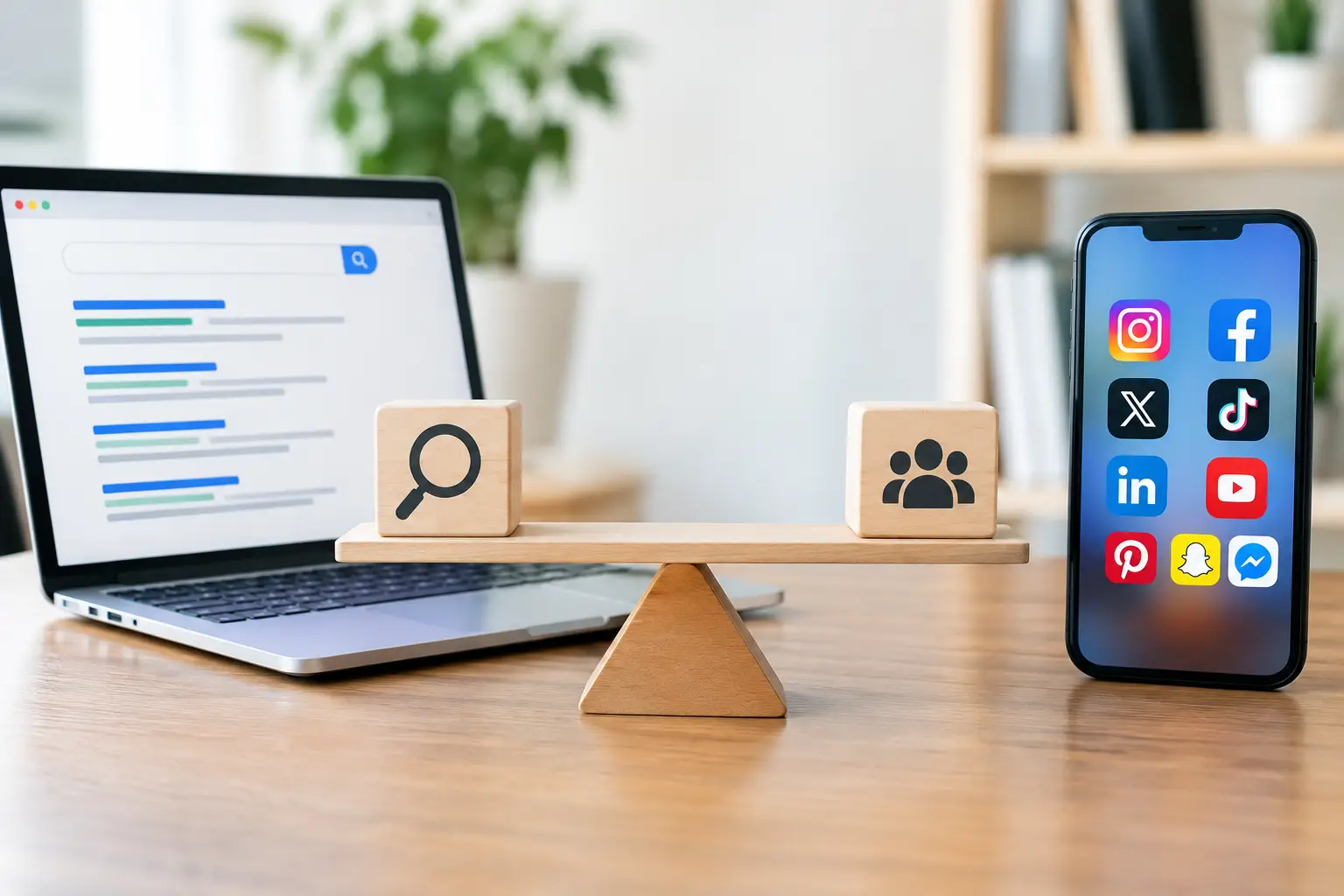
A homeowner with a leaking roof does not scroll Instagram hoping to find a roofer. They search Google, check reviews, call two or three companies, and hire the one that looks credible and available. That is the core difference in SEO versus social media marketing: one channel captures existing demand, while the other often creates awareness before demand is urgent.
Small business owners are frequently told they need to be everywhere. More posts. More videos. More followers. More activity. But activity is not revenue. If your phone is not ringing, your calendar is not filling, or your sales pipeline is thin, the right question is not which platform is more popular. It is which channel puts your business in front of people most likely to buy.
For many local service businesses, SEO should be the foundation. Social media can strengthen trust, build familiarity, and support advertising, but it rarely replaces the buying intent found in search.
SEO Versus Social Media Marketing: The Intent Difference
SEO puts your business in front of people who are actively looking for an answer. Someone searching "emergency plumber near me," "Ocala divorce lawyer," or "best AC repair in Crystal River" has a clear problem and is close to taking action. They are not browsing for entertainment. They need help.
That makes search traffic valuable. A person who finds your business through a well-optimized service page, a strong Google Business Profile, or a local map result is already moving toward a decision. Your job is to make that decision easy: show proof, explain the service clearly, display reviews, answer objections, and make calling or booking simple.
Social media works differently. Most people open Facebook, Instagram, TikTok, or LinkedIn to catch up, be entertained, follow interests, or pass time. They may become aware of your business there, but they did not arrive with the same immediate intent to hire you.
That does not make social media useless. It means you should judge it by the job it can realistically do. A local remodeling contractor may use before-and-after project photos to build confidence. A dentist may use short videos to reduce anxiety about treatment. A restaurant may promote specials, events, and new menu items. These efforts can influence future buyers, but they may not produce the same dependable volume of high-intent calls as local search.
When SEO Produces the Better Return
SEO is usually the stronger long-term investment when your customers search before they buy. This is especially true for home services, legal services, healthcare, repair companies, professional services, local retail, and other businesses where customers have a specific need, location, and deadline.
A good SEO strategy does more than place keywords on a website. It fixes the visibility and conversion gaps that cost you business. That includes technical site performance, local service pages, Google Business Profile optimization, accurate business listings, review strategy, useful content, clear calls to action, and a website that works properly on a phone.
The payoff is cumulative. A properly built page can generate calls for months or years. Strong map visibility can keep producing direction requests and phone calls without requiring you to pay for every click. That is a meaningful advantage for owner-operated businesses that need predictable lead flow rather than a constant content treadmill.
SEO also creates an asset you control more directly. Search algorithms change, and rankings require ongoing work, but your website, your reviews, your business information, and your local authority are part of your digital foundation. They do not disappear because one social platform changes its feed or your reach drops overnight.
The trade-off is speed. SEO is not an instant switch. New websites, competitive markets, and businesses with weak local signals need time to earn traction. If you need leads this week, paid search may help bridge the gap while SEO compounds. But if you only buy short-term attention and never strengthen your search presence, you stay dependent on the next ad budget.
SEO is strongest when customers search with urgency
A locksmith, water damage company, towing provider, HVAC contractor, or attorney does not need to convince every customer that the service category exists. The customer already knows. The business needs to be visible at the exact moment of need and look more trustworthy than the alternatives.
For these businesses, being absent from the local map pack or buried on page two is not a branding problem. It is missed revenue going to a competitor who showed up first.
When Social Media Marketing Is Worth the Investment
Social media earns its place when visual proof, personality, community, or repeat engagement drives the sale. Businesses with compelling transformations, products, events, education, or a loyal local following can get real value from consistent social content.
A salon can showcase results. A fitness studio can demonstrate culture. A boutique can create demand around new inventory. A custom builder can use project walkthroughs to establish craftsmanship before a homeowner ever begins searching. In these situations, social media helps prospects remember your name and develop trust.
It can also work well for retargeting. Someone visits your website, reviews a service page, and leaves without calling. Social ads can keep your business in front of that person with testimonials, project examples, offers, or reminders. That is far more strategic than posting every day and hoping the algorithm happens to deliver a lead.
Paid social can be effective for offers people may not be actively searching for. A med spa promoting a seasonal treatment, a gym offering a trial, or a local retailer announcing a sale can create response through targeted advertising. The message, offer, creative, audience, landing page, and follow-up process all matter. Boosting a random post is not a lead-generation plan.
The downside is ownership and consistency. Organic reach is unreliable, especially for small business pages. A large follower count can look impressive while producing little revenue. If the audience is not local, not qualified, or not ready to buy, likes do not pay the payroll.
Social media is strongest when trust needs to build first
Some purchases take time. A homeowner may follow a designer for months before planning a renovation. A prospective patient may watch a physician's educational videos before scheduling. A business owner may see a consultant's insights repeatedly before asking for help.
Social media can shorten that trust gap. But it works best when it supports a clear path to conversion: a credible website, a focused service offer, proof of results, and a simple next step. Otherwise, attention stays attention.
How to Decide Where Your Budget Goes
Start with the economics of your business, not the marketing trend. Ask how customers currently find providers like you. If they turn to Google with a problem in hand, prioritize local SEO, your Google Business Profile, and a website built to convert. If buying decisions depend heavily on visual discovery, community engagement, or repeated exposure, assign meaningful resources to social media as well.
Then look at your sales cycle. A business that needs immediate inbound calls should not rely solely on slow-burn content. A business with a longer consideration period should not ignore the trust-building value of video, social proof, and ongoing visibility.
Your current gaps matter too. If you have a neglected website, weak reviews, inaccurate listings, and no map visibility, social posting will not fix the core problem. You are sending attention into a broken system. Fix the foundation first.
For many small businesses, the practical answer is not SEO or social media. It is a priority order. Build search visibility and conversion infrastructure first. Use social media to reinforce credibility, retarget interested visitors, demonstrate expertise, and stay top of mind. Add paid advertising when you need faster volume and can track whether the leads turn into profitable jobs.
Measure Leads, Not Applause
The only fair way to compare channels is to track what happens after the click, view, or call. Measure qualified leads, booked appointments, estimates, close rates, customer value, and cost to acquire a customer. If possible, track which leads become revenue rather than stopping at form submissions.
A social campaign that generates 50 inquiries may be less valuable than an SEO campaign that generates 12 calls if the SEO callers are ready to buy and close at a higher rate. Likewise, a page-one ranking is not enough if visitors cannot quickly find your phone number, understand your offer, or trust your business.
Jeff Norton Digital approaches this as a visibility and conversion problem. The goal is not more marketing noise. The goal is to identify where prospects are dropping off, repair the system, and make every channel accountable to business growth.
Your next customer is probably not asking which marketing channel you chose. They are simply looking for a business they can find, trust, and contact without friction. Put your budget where that moment is most likely to happen, then measure the result without excuses.