You do not have a traffic problem if people are already searching for what you sell and your competitors keep getting the calls. You have a visibility problem, a conversion problem, or both. That is why the seo vs paid ads question matters so much for small businesses. Pick the wrong channel, or use the right one at the wrong stage, and you can burn months of momentum or thousands of dollars without much to show for it.
Most business owners are told to treat SEO and paid advertising like rivals. That is too simplistic. One is not automatically better than the other. The real question is which one solves your revenue problem right now, with your budget, in your market, and on your timeline.
SEO vs paid ads: the real difference
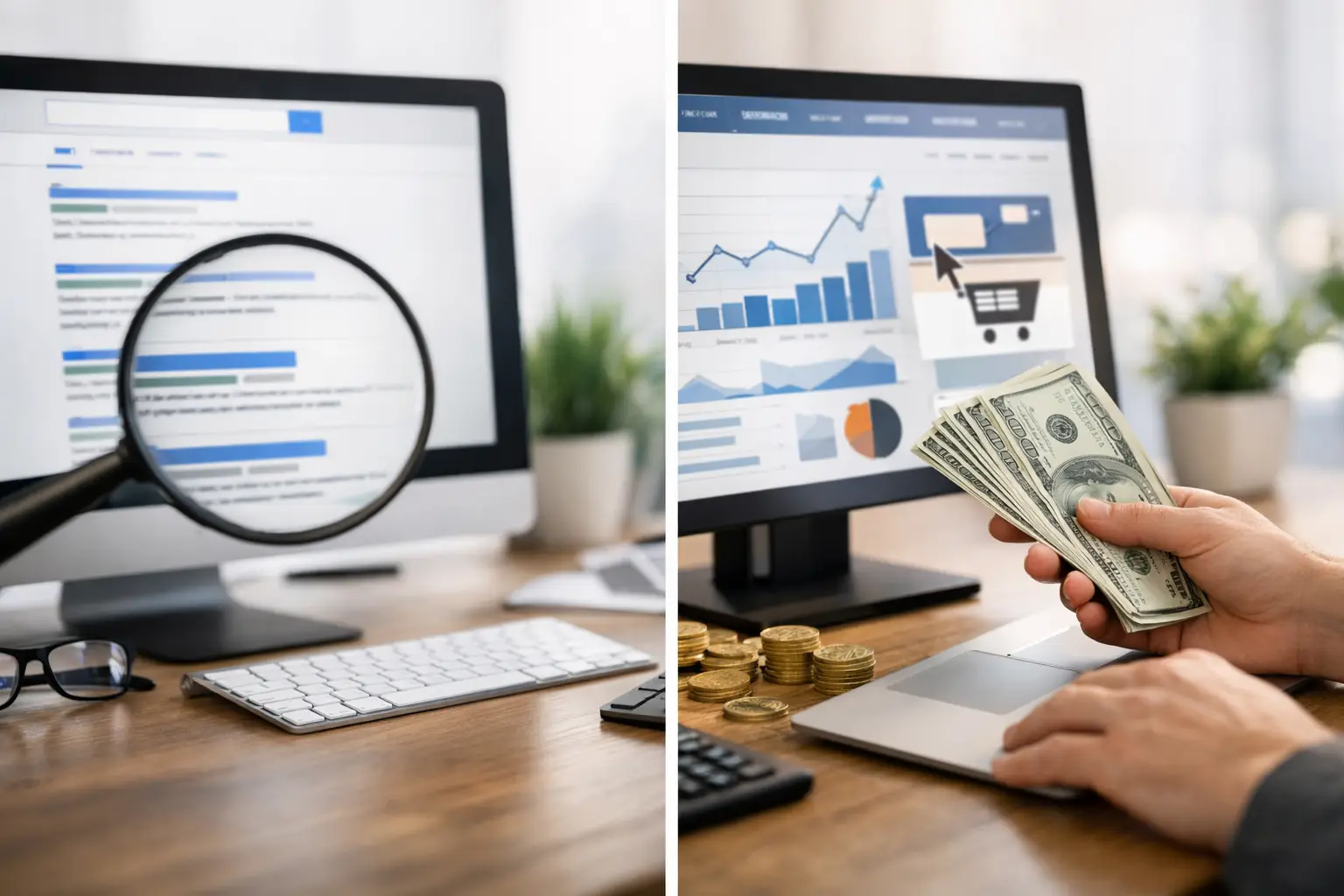
SEO earns visibility over time. Paid ads buy visibility right away. That is the simplest way to frame it, but the business impact goes deeper.
SEO helps your business appear in organic search results, map results, and increasingly in AI-driven search experiences. If your site is technically sound, your local signals are strong, and your pages actually match what buyers are searching for, SEO can produce leads without paying for every click. It compounds. A page that ranks today can keep generating calls next month and next quarter.
Paid ads work differently. Google Ads, Local Services Ads, and Meta campaigns let you put your business in front of people immediately. You can target specific searches, service areas, and audiences, then track what happens. It is fast, controllable, and useful when you need demand now. The downside is obvious. When you stop paying, the traffic stops.
That does not make paid ads worse. It makes them rented attention. SEO is owned visibility, at least to the extent that your rankings are earned and maintained.
When SEO is the better investment
If you are a local service business with steady search demand, SEO is usually the smarter long-term bet. Think plumbers, roofers, dentists, family law firms, med spas, HVAC companies, accountants, and home service providers. People already search for these services with strong intent. If your business can show up in local results at the moment someone needs help, that traffic tends to convert well.
SEO is especially strong when your sales cycle starts with a search, a phone call, or a form submission. It also matters more when trust is part of the purchase. Many buyers skip ads and go straight to the businesses that look established in organic results, local map listings, and review profiles.
There is another reason SEO matters now. Search is no longer limited to ten blue links. Google Business Profile visibility, AI summaries, and recommendation engines are changing how businesses get discovered. A company with a strong site, clear service pages, consistent local authority, and strong brand signals has a better shot at showing up across more surfaces than a company relying only on ad spend.
The trade-off is speed. SEO takes time. If your website is weak, your local profile is incomplete, your technical foundation is broken, or stronger competitors have been investing for years, you should not expect instant rankings. Good SEO works, but it is not magic and it is not immediate.
When paid ads make more sense
Paid ads are the right call when speed matters more than compounding. If you need leads this month, have a new location, want to test a service, or need to make up for slow season, ads can create fast opportunity.
They are also useful when organic rankings are weak and you cannot wait six months for SEO gains to mature. A solid Google Ads campaign can put you in front of high-intent buyers while your organic presence is being rebuilt.
Paid ads also give you cleaner testing. You can learn which offers get clicks, which service lines convert best, which locations respond, and what messaging actually drives action. That data can sharpen your landing pages, your SEO strategy, and even your sales process.
The catch is that paid ads punish sloppy execution. If your landing page is weak, your call handling is poor, your targeting is broad, or your campaign is sending people to the wrong page, your budget disappears fast. Too many businesses think ads failed when the real issue was no conversion system behind them.
The biggest mistake in seo vs paid ads
The biggest mistake is treating traffic like the goal. It is not. Revenue is the goal.
A business can rank well and still lose money if the website is slow, confusing, or built around vanity instead of action. The same business can run ads and get plenty of clicks but very few calls because the page does not build trust or the offer is weak. Neither SEO nor paid ads fixes a broken conversion path by itself.
This is where a lot of agencies hide. They report impressions, click-through rates, and keyword movement while the owner is still asking the same question at the end of the month: did this bring in business?
That is the standard to use. Not more visibility in isolation. More qualified calls, more booked jobs, more consultations, more revenue.
How to choose based on your business stage
If you are early-stage or entering a new market, paid ads usually deserve the first dollars because they create immediate feedback. You can see what people respond to, which services drive demand, and whether your pricing and messaging hold up.
If you already have an established business and a decent reputation but weak online visibility, SEO often offers the larger upside. You have proof that the business works. What you need is a stronger digital footprint so you are not losing ready-to-buy customers to competitors who simply show up first.
If your budget is tight, the answer depends on your timeline. A business that needs calls now may not have the luxury of waiting for SEO to build. A business that can invest consistently for the next six to twelve months should not ignore the long-term return SEO can create.
If your market is highly competitive, it usually is not either-or. Competitive categories often require both. Ads let you compete now. SEO builds a stronger position so you are not paying for every lead forever.
Why the best answer is often both
For most small businesses, the strongest strategy is not SEO or paid ads. It is sequencing them correctly and making them work together.
Paid ads can generate leads while SEO gains traction. SEO can reduce dependency on ad spend over time. Ad data can reveal the keywords and offers worth building into organic pages. Organic search can improve brand familiarity, which often raises ad click-through and conversion rates. Together, they create coverage at different stages of the buyer journey.
This combined approach works best when the foundation is solid. That means a fast website, clear service pages, local trust signals, strong calls to action, accurate tracking, and someone actually reviewing what turns into revenue. Otherwise you are just paying to send people into a leaky funnel.
A performance-focused agency should diagnose that before recommending budget allocation. At Jeff Norton Digital, that is the entire point of the conversation. Not selling a channel for the sake of selling a channel, but identifying where visibility is breaking down and where conversion is leaking money.
What small business owners should ask before spending
Before you decide between SEO and ads, ask a few blunt questions. Do you need leads immediately, or can you invest for long-term growth? Are people already searching for your service in your market? Does your website convert traffic into calls or forms? Can you track where leads actually come from? Are you prepared to keep funding ads month after month, or do you want to build an asset that keeps working over time?
Those answers will tell you more than any generic marketing advice.
If you need fast demand, paid ads are often the right move. If you want stronger margins and more durable visibility, SEO usually wins over time. If you want to build a business that is harder for competitors to outrank and easier for customers to find across search platforms, you should stop framing this as a fight and start treating it like a growth system.
The smart move is not choosing the louder channel. It is choosing the one that solves the next bottleneck in your business, then building from there.
Not sure whether SEO or paid ads is right for your business? Jeff Norton Digital offers a free audit that identifies where visibility is leaking and which channel will move the needle fastest for your specific market. Request your free audit here.