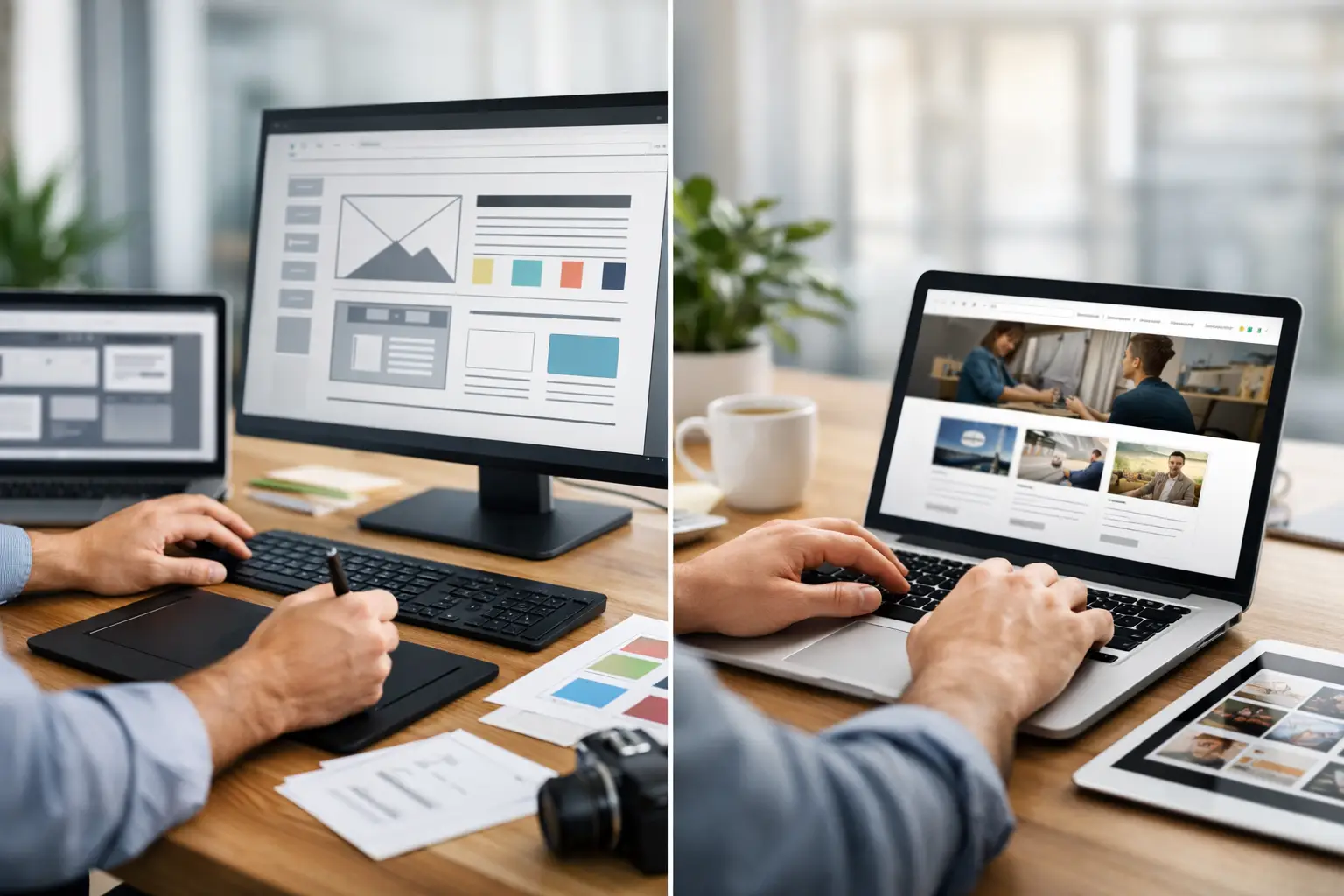
A website that looks fine but fails to produce calls is not a bargain. It is a leak in your marketing budget. The custom website vs template website decision matters because your site is often the place where a prospect decides whether to contact you, keep searching, or call the competitor who made the next step easier.
For a small business, the right answer is not always "custom." A well-selected template can get a new business online quickly and affordably. But when you rely on Google rankings, local visibility, estimates, appointments, or online sales, the limits of a template can become expensive fast. The real question is not which option is prettier. It is which one supports the revenue goal you have right now.
Custom Website vs Template Website: The Real Difference
A template website starts with a prebuilt layout. You choose a theme, replace the demo copy and images, adjust colors, add pages, and publish. Platforms make this process accessible because the structure is already there. For a business with a tight startup budget, a simple offer, and little competition, that speed has real value.
A custom website is designed and built around your business, your customers, and the actions you need visitors to take. That does not simply mean a different color palette or an expensive homepage. It means the site structure, messaging, service pages, calls to action, forms, mobile experience, technical setup, and conversion paths are planned intentionally.
That distinction affects everything downstream. A template asks your business to fit into an existing framework. A custom site makes the framework fit your sales process. If you are weighing the two options against each other, it is also worth reading about the difference between a custom website and a page builder, since many templates are sold through builder platforms that come with their own limitations.
When a Template Website Makes Sense
Templates are not automatically bad. They are tools, and the right tool depends on the job. A template can be a smart first move if you are validating an idea, operating with a very limited budget, or need a basic online presence while you build the business.
For example, a new local consultant who needs a clean five-page brochure site may not need custom development on day one. If the primary goal is credibility -- showing services, contact information, and a few testimonials -- a quality template can do the job. The same may be true for a short-term event site, a simple portfolio, or a business that gets nearly all of its work through referrals.
The problem begins when owners treat a starter site as a growth system. A template can display your phone number. That does not mean it is structured to attract qualified search traffic, answer buyer objections, build trust, and turn visitors into calls.
Most template sites also look efficient during setup because the difficult decisions have been postponed. You still need clear copy, professional images, service-page strategy, local SEO fundamentals, tracking, and a reason for visitors to choose you. Without those pieces, a polished theme is just a digital business card sitting in a crowded drawer.
Where Template Sites Start Costing You Leads
The biggest weakness is rarely the design itself. It is the lack of strategic control.
Many templates are built to appeal to the widest possible audience. That often means generic page structures, bloated code, unnecessary features, and design choices that do not reflect how your customers actually buy. A plumber in Ocala, a roofing contractor in Crystal River, and a medical practice in Inverness should not all be forced into the same sales path just because the template demo looked good.
Search visibility can suffer when the site has weak page hierarchy, limited service-page depth, poor internal navigation, slow load times, or thin location relevance. Google needs to understand what you do, where you do it, and why your pages deserve to rank. AI-driven search tools also need clear, credible information they can interpret and recommend. A generic website gives both systems less to work with.
Conversion is the other major issue. If your high-value service deserves its own focused page, your template may push it into a crowded dropdown menu. If your customers need to see financing information, project proof, reviews, FAQs, service areas, and a quick quote option before they call, the standard layout may bury those trust signals. Every extra click and unanswered question creates another chance for a prospect to leave. Understanding what makes a website convert better is essential before deciding whether a template can meet that standard.
Then there is the ownership issue. Some low-cost website packages lock you into proprietary builders, restrict edits, or charge heavily for changes. You may think you bought a website when you actually rented a limited setup that cannot grow with the company.
What a Custom Website Should Actually Deliver
A custom website is worth the investment only when it is built to solve business problems. A flashy homepage alone is not a strategy.
First, it should make your value clear quickly. Visitors should know what you do, who you help, where you operate, and what action to take. That sounds basic, yet many business websites lead with vague slogans instead of a clear offer. People do not call because a website says it delivers excellence. They call because it answers their need better than the alternatives.
Second, custom web design creates a structure that supports search growth. Each important service can have a dedicated page built around real customer intent. Your site can organize service areas logically, demonstrate expertise with useful supporting content, and connect pages in a way that helps users and search engines understand the business. Technical SEO is easier to manage when the site was planned properly instead of patched together after launch.
Third, it should reduce friction. That could mean click-to-call buttons and conversion-focused features that stay visible on mobile, quote forms that ask only what your team needs, booking options for appointment-based businesses, or landing pages built specifically for paid ad traffic. A custom site lets you design the next step around how your office handles leads, not around whatever form module came with a theme.
Finally, it should give you usable data. You need to know which pages drive calls, which campaigns create leads, and where prospects drop off. Without attribution, business owners are left guessing whether their marketing is working. With it, you can improve the pages and campaigns that are actually producing revenue.
Jeff Norton Digital builds custom websites designed around your specific sales process, service pages, and conversion goals -- not around a theme developer's demo. The result is a site that earns visibility and produces measurable inquiries rather than simply existing online.
The Cost Comparison Most Owners Miss
A template usually costs less upfront. That is the obvious advantage. But upfront price and total cost are not the same thing.
Suppose a template site saves you several thousand dollars but converts only one fewer qualified lead each month than a strategically built custom site. For a contractor, attorney, clinic, or other high-ticket service business, one lost customer can erase those savings quickly. Add weak rankings, a slow mobile experience, and repeated developer fixes, and the cheap option can become the more expensive choice.
Custom websites require a larger initial investment because discovery, strategy, content planning, design, development, and testing take time. They are not the right choice for every business at every stage. But if your website is expected to generate leads rather than merely exist, it should be evaluated like a salesperson. A salesperson who misses calls, gives vague answers, and confuses prospects would not stay on payroll. Your site should not get a pass either.
If you are also evaluating what your site should include once you build it, reviewing the best website features for conversions gives a clear benchmark to work from regardless of which path you choose.
How to Choose the Right Website for Your Business
Start with your growth target. If you need a credible online presence while you establish the company, a strong template may be enough. Choose one that loads quickly, works well on mobile, gives you control of the basics, and does not trap you in a restrictive platform.
If you want to rank in competitive local searches, run paid campaigns, expand service lines, sell online, or generate a predictable volume of inquiries, custom is usually the better business decision. Those goals require more than a good-looking homepage. They require a site built around search intent, trust, speed, and conversion.
Ask practical questions before choosing either path. Can you create focused pages for every profitable service? Can you clearly show proof, reviews, credentials, and differentiators? Can the site be updated as your business changes? Can you track form submissions and phone calls? Is it fast on a real customer's phone, not just attractive in a desktop preview?
If the answer is no, the platform or plan is not supporting your growth. It is limiting it. The team at Jeff Norton Digital's web design services is built around answering yes to all of those questions for businesses that are ready to compete online.
Do Not Buy a Website You Will Outgrow in Six Months
The best website is not the one with the most animations or the lowest invoice. It is the one that meets your current needs without blocking the business you are trying to build next.
For some owners, that means launching a disciplined template site now and planning a custom build after the first growth milestone. For established service businesses that are tired of being outranked, ignored, or buried under competitors with better digital infrastructure, delaying the custom build may mean continuing to lose leads already searching for what you offer.
Treat your website as a revenue asset. When it clearly communicates your value, earns visibility, and gives ready-to-buy customers an easy reason to call, it stops being an expense and starts doing the job it was supposed to do. If you are considering a rebuild, the process of rebuilding an outdated business website covers what to prioritize and what to avoid so the investment pays off from day one.