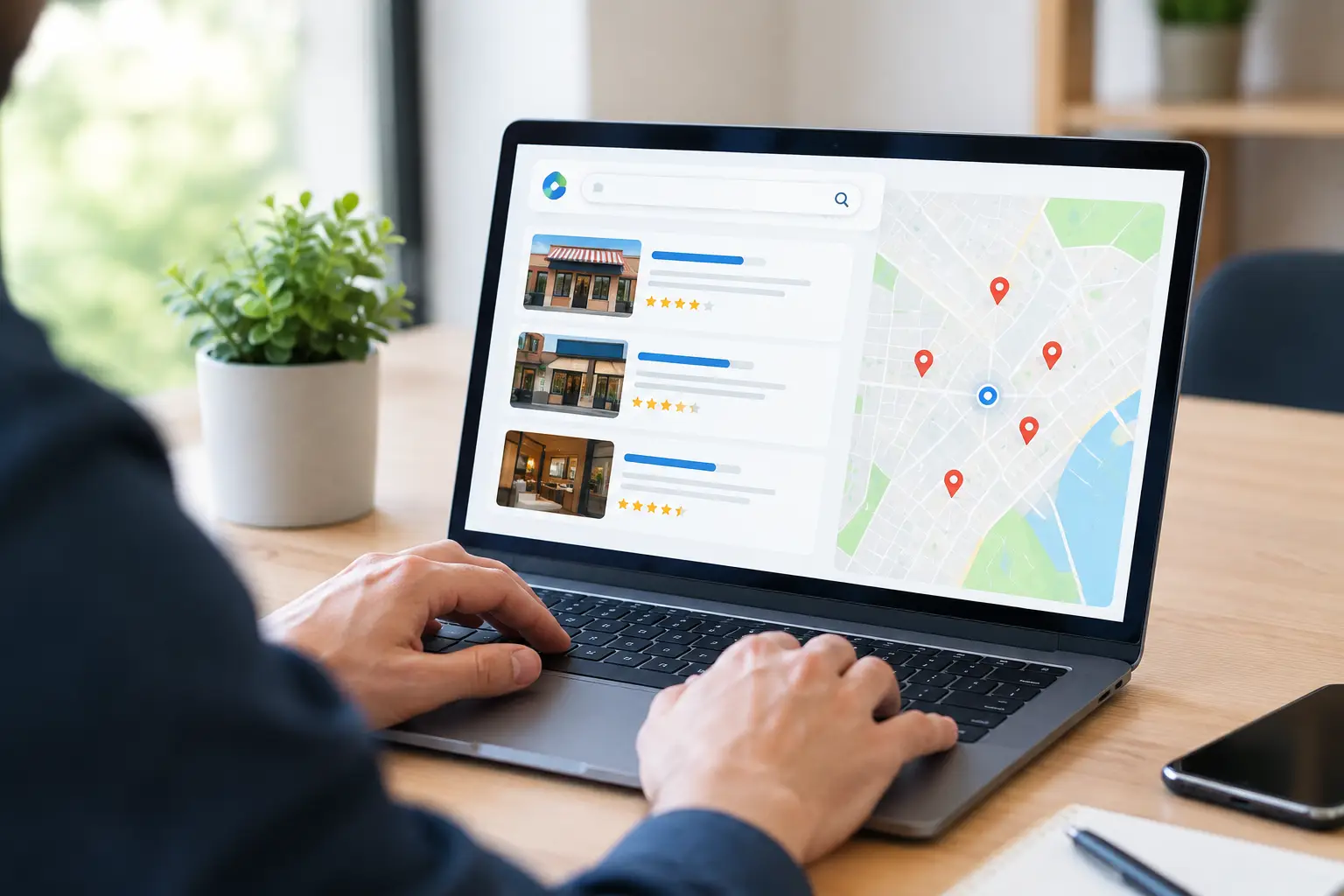
A homeowner does not always search "plumber near me" anymore. They may ask ChatGPT: "Who are the best emergency plumbers near Ocala that can handle a water heater leak tonight?" That question changes the game. A useful ChatGPT search results example shows why: the answer may name only a few businesses, explain why each is relevant, and cite the sources it used. If your company is not part of that answer, you are not just losing a ranking. You may be losing the call before the customer ever sees your website.
Understanding what AI search visibility means for your business is the first step. The second step is knowing what to do about it.
What a ChatGPT Search Results Example Can Look Like
Imagine a customer asks ChatGPT this:
"Find a highly rated roof repair company in Citrus County that works on storm damage and offers fast estimates."
A search-enabled AI response might look something like this:
"For storm damage roof repair in Citrus County, consider ABC Roofing, which highlights emergency repair services and storm-damage inspections. XYZ Restoration may also be a fit if you need help documenting damage for an insurance claim. Before booking, confirm current availability, licensing, service area, and whether the estimate is free."
Below that response, ChatGPT may display citations or source cards from company websites, Google Business Profiles, review platforms, directories, local news coverage, or other authoritative pages. The exact format changes by platform, query, user location, and available information. But the business lesson is consistent: AI search does not simply return ten blue links and leave the customer to sort it out.
It tries to make a recommendation.
That means the visibility problem is no longer only, "Do I rank on Google?" It is also, "Does the information AI finds about my business give it enough confidence to recommend me?"
Why This Matters for Local Service Businesses
A traditional search result gives a prospect a list. An AI-generated answer often narrows that list based on the details inside the question.
A customer may specify that they need a licensed electrician, same-day service, financing, a provider open on weekends, a business that serves a certain town, or someone experienced with a particular repair. If your site and business listings do not clearly communicate those facts, an AI system has less evidence to include you.
This is where many small businesses lose ground. Their website may say "quality service you can trust," but it never clearly states the services offered, the areas served, the qualifications held, the job types handled, or the proof behind the claims. That vague copy might have been passable five years ago. It is weak fuel for AI search.
The businesses that get surfaced are often not magically better. They are simply easier to understand, verify, and cite. This is a core principle behind AI search optimization for local businesses.
What ChatGPT Is Looking for When It Builds an Answer
No one outside the platform can promise exactly how every ChatGPT result will be generated. Results can shift as sources change, as the customer changes the wording of the question, and as the platform updates its product. Anyone selling guaranteed placement in every AI answer is selling certainty they do not control.
Still, the patterns are practical. AI search systems need credible, relevant information to answer a question. For a local business, that usually comes down to four areas:
- Clear service relevance
- Local relevance
- Trust and proof
- Consistent business information across the web
Clear service relevance
If you install water heaters, say so clearly. If you repair tankless water heaters, say that too. If you offer emergency plumbing, leak detection, repiping, or commercial work, each service needs its own useful explanation.
Do not bury your actual offerings beneath generic sales language. A search system cannot confidently match your company to a detailed customer need if the details are absent or confusing.
Local relevance
A business that serves Ocala, Inverness, Crystal River, Belleview, or nearby communities should communicate that honestly and specifically. Service area information needs to match reality. Adding every city in Florida to a page will not create trust, and it can create a poor experience for real customers.
For businesses with a physical location, accurate profile data matters. For service-area companies, the website should make it easy to understand where crews actually travel and which services are available in each market.
Trust and proof
AI answers tend to favor information that can be supported. Your business should make it easy to verify who you are and why a customer should choose you. That includes clear contact details, licensing or certifications where relevant, years in business, team information, real customer reviews, project examples, policies, and straightforward service descriptions.
A thin website with anonymous stock photos and no proof creates doubt. A polished site alone is not enough either. The content must answer the questions a skeptical customer would ask before spending money.
Consistency across the web
Your business name, phone number, address, service categories, and core descriptions should not conflict from one platform to another. Inconsistent listings make it harder for customers and systems to determine what is accurate.
That does not mean copying the same paragraph everywhere. It means keeping the core facts aligned while building a credible footprint. When one source says you are open seven days a week and another says you are closed on weekends, you have created a recommendation problem.
How to Read a ChatGPT Search Results Example Like a Marketer
Do not look at an AI result and ask only, "Was my business named?" Look at the answer like a diagnostic report.
First, study the customer's wording. What need did they express? Was it urgent? Did they mention a location, budget, job type, qualification, or service feature? Those modifiers are where buying intent lives.
Next, look at the businesses that appear. What reasons does the answer give for including them? You may see references to specialties, reviews, proximity, industry experience, availability, or insurance-related services. Those details reveal the signals competitors have made visible.
Then inspect the cited sources. Are competitors being supported by detailed service pages, local profiles, editorial mentions, customer reviews, or directory pages? If your own site has no equivalent evidence, you have found a gap that needs fixing.
Finally, check whether the answer gives a direct recommendation or merely offers options. For high-stakes services such as legal work, health care, home repair, or financial decisions, AI may hedge and tell the user to verify credentials. That is not a failure. It is a reminder that your online presence needs to reduce uncertainty at every step. The same diagnostic approach applies when optimizing for Perplexity search and other AI platforms.
The Difference Between Being Mentioned and Being Chosen
A mention can create awareness. It does not guarantee a lead.
If ChatGPT names your business but a customer clicks through to a slow, outdated website with no clear phone number, unclear services, and weak proof, the opportunity dies on your own property. AI visibility and conversion are tied together. One without the other leaves revenue on the table.
Your website should answer the next question before the visitor has to ask it. What do you do? Where do you work? Why should they trust you? How quickly can they get help? What should they do now?
For local service businesses, the conversion path should be simple. Prominent calls, fast-loading pages, clear service information, strong reviews, and an easy way to request service do more than improve user experience. They make the business easier to choose when the prospect is ready to act.
A Practical AI Search Visibility Checklist
Start with the assets you control. Make sure your website has a dedicated, substantial page for each major revenue-driving service. Explain the problem, the service, who it is for, what the process looks like, and the areas served. Add original proof where you have it, including real project photos, testimonials, certifications, and answers to common pre-sale questions.
Then clean up your local presence. Your Google Business Profile should accurately reflect your business name, category, hours, phone number, service area, and services. Review your major listings for outdated details. Ask satisfied customers for honest reviews, and respond professionally to the reviews you receive.
After that, test real customer prompts. Use queries that reflect how people buy, not just the short keywords tracked in old SEO reports. Try questions such as "best," "near me," "open now," "for [specific problem]," "that offers financing," or "that serves [city]." Record which competitors appear, what sources are cited, and what information your company lacks.
This work is not about tricking ChatGPT. It is about giving search platforms and customers accurate, useful reasons to trust your business. Businesses that have also examined Google AI Overview optimization will find many of the same principles apply here.
AI Search Is an Accountability Test
ChatGPT search results expose the difference between a business that has a real digital presence and one that merely has a website. If your competitors are consistently recommended, they have likely built clearer signals around relevance, authority, and trust -- whether they planned for AI search or not.
The opportunity is real, but it depends on your market. A specialized B2B company may see fewer AI-driven leads than an emergency home service provider. A local company in a competitive market may need stronger reviews, better service pages, and cleaner technical SEO before it earns consistent visibility. There is no one-button fix.
Jeff Norton Digital approaches this as a revenue diagnosis, not an AI gimmick. The goal is to identify where a business is being overlooked, strengthen the evidence customers and search systems need, and turn that visibility into calls, appointments, and sales. The AI search ranking trends shaping small business visibility make this work more urgent, not less.
The next time you see a ChatGPT answer recommend a competitor, do not treat it as bad luck. Treat it as evidence. The answer is showing you what customers can find, what they cannot, and where your business needs to become the clearer choice.